
 |



Two years ago, the Polytechnical Institute of Noordelijke Hogeschool Leeuwarden in Holland (NHL) introduced a collection of online math exercises using Maple T.A.® Since then, 95% of the engineering students who regularly evaluated their math knowledge with Maple T.A. online exercises passed with significant improvement in their final scores. Many of the students who did not regularly test their skills using these exercises failed the course.
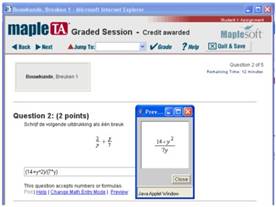
Maple T.A. ® is an easy-to-use web-based system for creating tests and assignments and automatically assessing students’ abilities. Maple T.A. supports complex, free-form entry of mathematical equations and intelligent evaluation of responses, making it ideal for mathematics, science, or any course that requires mathematics. Maple T.A. uses the well-known Maple® math engine from mathematics software provider Maplesoft®.
They say Practice Makes Perfect and students at NHL have proved it right over the last two years. Students who regularly used these exercises to test their knowledge and practise concepts they found challenging showed significant improvement to their final test results.
Each exercise is designed to be solved in 15 minutes and includes 5 questions. Students have the option of trying exercises in a particular topic as many as four times. The randomization of Maple T.A. is one of its biggest strengths – students never get the same tests or exercises, which helps them to practice new problems each time.
Maple T.A. also offers a wide range of question types, including the ability to have multiple response areas in a single question and to ask open questions that are graded for mathematical equivalency using the Maple engine. The variety of question types, along with the randomization capabilities of the system, provides a rich environment that enables the use of advanced questions to truly test a student’s knowledge level. The objective of the exercises is to get more than 80% of the answers right. If a student fails after four attempts, it is an indication they should seek help on their basic theoretical knowledge of the concepts presented.

The implementation of Maple T.A. at NHL started in 2005 when it was spurred on by math teacher Metha Kamminga. “We wanted to implement a flexible system that gives students the desire to work with math. Today, 95% of the students succeed in the final tests if they have done the exercises regularly during the year. Results of the final tests were very disappointing 5 years ago, but have now improved significantly. Students love that they can take these exercises at their own time, in the convenience of their own homes and at their own pace. What’s more, they get immediate feedback too. This can be very inspiring and motivating,” Kamminga says.
In the beginning, Kamminga had to build a few extra exercises to teach students how to enter a math formula correctly. But Maple T.A. contributes to teaching them the rigorous syntax of math in a precise fashion, and students have quickly adopted the system. They appreciate the possibility to get graded again and not being dismissed at the first mistake on an exercise. With each passing trial, they get better.
“Building the exercises, I particularly appreciated the simple interface of Maple T.A. and the personalisation capabilities of the test. With these tests, each student gets personal attention in areas where they need it and they feel like they are well looked after,” adds Kamminga. “Before Maple T.A., this was done with paper tests and my Sunday mornings were spent correcting too many paper exercises. The system is now fully automated. Furthermore, we have created a participative teaching system. I am now like a “virtual teacher” who is always around the students when they work, but I get my Sunday mornings free!”
Analysis also showed that Kamminga was able to move faster in her course and cover wider and deeper topics with the vast amount of time now saved. At the same time, students are also well prepared to take on new challenges since they have rigorously practiced these Maple T.A. exercises.
NHL has great plans to take their use of Maple T.A. forward. At Kamminga’s urging, NHL intends to extend the use of Maple T.A., for other subjects like physics and statistics. Towards that end, a specific Maple T.A. course for teachers will be held in the next few months. A web site named Wisnet (www.wisnet.nl) has been developed, which is a project for generating computerized mathematical content making all tutorials and math exercises available in a digital form to a wider group of people.
About Metha Kamminga
 Contact Maplesoft to learn how Maple can be used for your projects
|
 |
|
© Maplesoft, a division of Waterloo Maple
Inc. 2016. | Terms of Use | Privacy | Trademarks MATLAB, Simulink, and Simulink Coder are trademarks or registered trademarks of The MathWorks, Inc. |
|





